
Writer: Sandra Alb
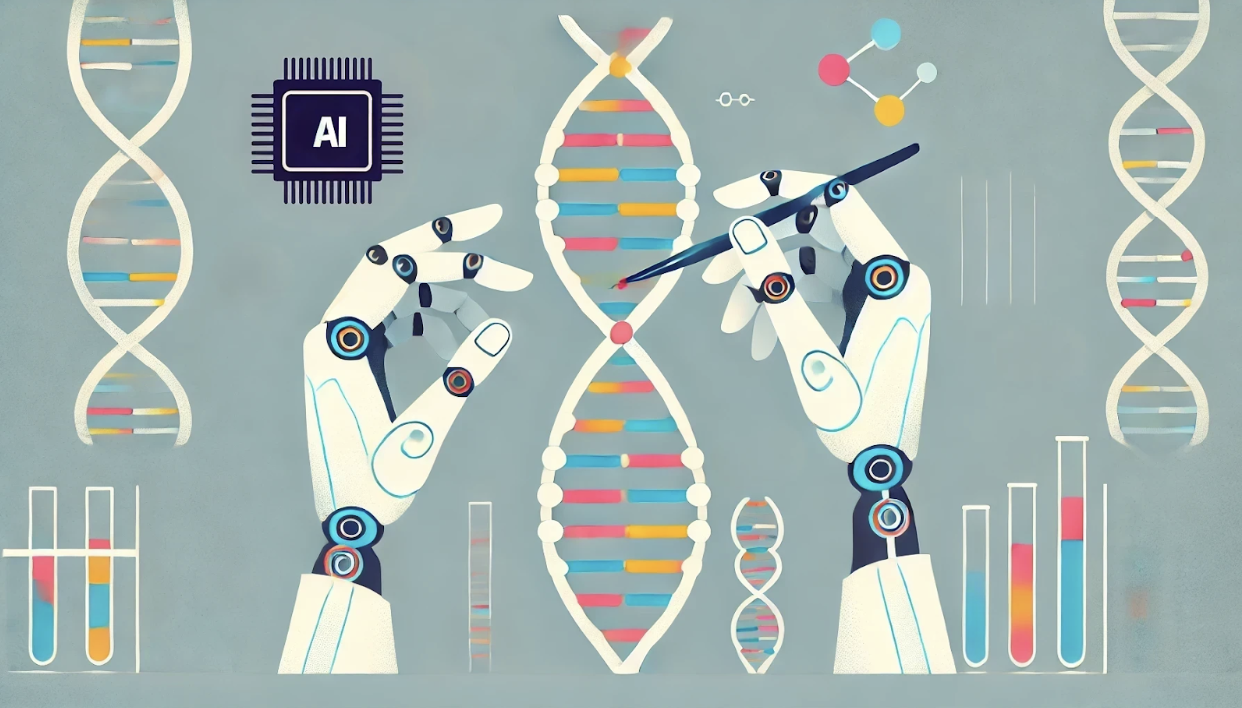
Can a robot write a symphony? Can a robot turn a canvas into a beautiful masterpiece?” Will Smith’s character asks an artificial intelligence (AI)-powered robot in the movie I, Robot. The answer might still be no for now, but as of July 2025, AI can rewrite our genome. Dr. Le Cong’s team at Stanford Medicine has published a new large language model (LLM) called CRISPR-GPT, which is designed to aid in planning and executing CRISPR-Cas9 genome editing experiments.
This technology is very similar to the more familiar ChatGPT, using the same “chat” prompting format to allow for human-AI collaboration in three modes: beginner, expert, and Q&A [1]. According to Cong, the goals of this technology are to reduce the trial and error associated with CRISPR-Cas9 gene editing and to minimize any adverse effects that may occur due to genomic manipulation. CRISPR-Cas9 makes genomic edits by using an RNA guide (gRNA) that matches a specific DNA sequence as a GPS signal to lead the Cas9 enzyme to the exact spot in the genome. Cas9 then cuts both strands of the DNA (forming double-stranded breaks, or DSBs), causing the cell’s natural repair machinery to kick in. It either patches up the break with insertion/deletion or adds a supplied template to make precise edits. This system allows scientists to remove, add, or change stretches of DNA in a controlled way [3]. AI deep learning models like inDelphi have already been used to ensure that DSB repair mechanisms proceed without error but CRISPR-GPT takes a much more AI-involved role in prompted gene editing. CRISPR-GPT is only a part of a larger shift toward using AI for precision in gene editing. Deep learning models can predict gRNA efficiency and editing outcomes, though inconsistent datasets and the lack of standard evaluation methods still limit progress [4].
While this new form of gene editing is exciting and holds the promise of curing countless diseases such as hereditary diseases, genetic disorders, potentially cancers and more, it also raises profound ethical questions. An AI companion like CRISPR-GPT would not only assist researchers in editing genes but could also, in theory, design and execute experiments far beyond human oversight. To address risks of AI misuse, Dr. Le Cong and his team have built safeguards into the system [2]. If CRISPR-GPT is prompted to engage in unethical activities, such as editing human embryos or enhancing viruses, it is programmed to issue a warning and respond with an error message, halting the interaction [2]. However, these measures introduce a deeper dilemma: what happens if someone alters the AI’s parameters or bypasses its restrictions? And more importantly, who gets to decide what counts as “ethical” in the first place? As AI systems become more autonomous and integrated into biological research, the line between innovation and interference grows thinner. Moving forward, a considerable challenge will be to ensure that technologies like CRISPR-GPT remain tools for healing, not harming, and that our ethical frameworks evolve as fast as the algorithms guiding them.
CRISPR-GPT is a powerful fusion of AI and biotechnology that could redefine how we approach genetic medicine. With such power comes an equally great responsibility to ensure these tools are guided by rigorous ethics. Now, as we stand at the intersection of code and creation, the question is no longer what AI can do, but what we should allow it to do.
References:
[1] Qu Y, Huang K, Yin M, et al. CRISPR-GPT for agentic automation of gene-editing experiments. Nat Biomed Eng. 2025. doi:10.1038/s41551-025-01463-Z
[2] Kay C. AI-powered CRISPR could lead to faster gene therapies, Stanford Medicine study finds. Stanford Medicine. September 16, 2025. Accessed October 17, 2025. https://med.stanford.edu/news/all-news/2025/09/ai-crispr-gene-therapy.html
[3] Asmamaw M, Zawdie B. Mechanism and applications of CRISPR/Cas-9-mediated genome editing. Biologics (Targets & Therapy). 2021;15:353–361. doi:10.2147/BTT.S326422
[4] Naert T, Yamamoto T, Han S, et al. Precise, predictable genome integrations by deep-learning-assisted design of microhomology-based templates. Nat Biotechnol. 2025. doi:10.1038/s41587-025-02771-0