
Writer: Makeen Shafer
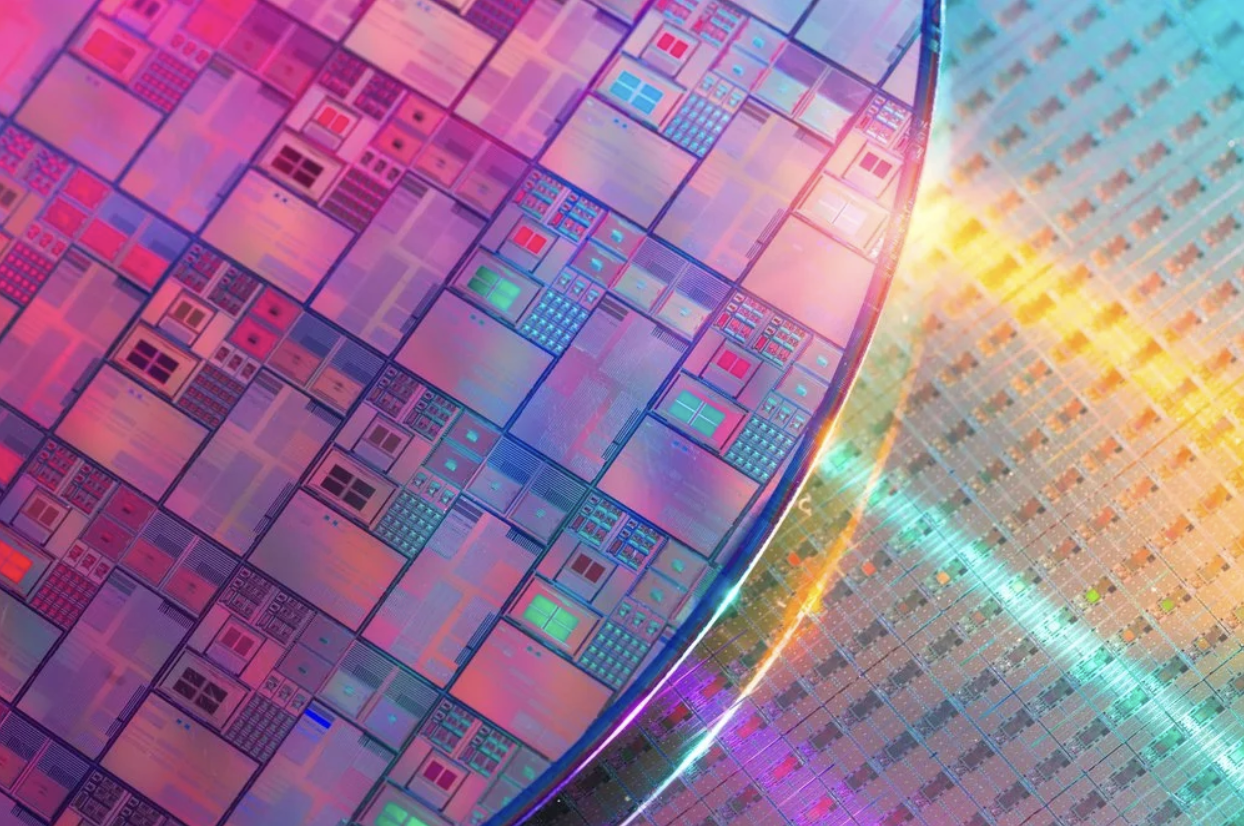
Pictured: Silicon wafer [1]
Ever wondered how a physical computer chip has information on it? Or how a solar panel turns light into electricity? Well the answer, in many cases, is a process called doping.
In materials science, doping is the highly tunable process that unlocks the hidden potential of ordinary materials. It's the art of adding precise, tiny, amounts of impurities to a substance to drastically transform its properties. Like salting pasta water, a little bit of doping goes a long way.
The star of modern doping is the semiconductor, its most famous being silicon. By itself, silicon is a poor conductor and a poor insulator of electricity, but with as few as one impurity atom per million silicon atoms, its conductivity can increase by over a thousandfold [2].
To understand how it works, let's take a step back. You might’ve learned in chemistry that different elements behave differently depending on their outermost valence electrons. For a material like silicon with four valence electrons, the impurity introduced, called a dopant, will have either one more valence electron (phosphorus) or one less electron (boron) [3]. This added electron (or “hole” where an electron is missing) in a system of silicon creates a mobile charge carrier, something that can move, in a material where there otherwise were no charges able to move [3]. Think of it like a football stadium where every seat is taken: when an electron is added, a new person can walk freely across the aisles, and when an electron is removed, a seat is freed up that anyone can move to.
Depending on whether the silicon was doped by increasing or decreasing electrons, an n-type semiconductor (more negative charge) or a p-type semiconductor (more positive charge) is created [3].
The real magic happens when p-types and n-types are put together. The simplest configurations make up diodes, components where electricity only flows in one direction from n to p, and transistors, the building blocks of computers [4]. For a chip, diodes control current flow and transistors control the 1s and 0s. For a solar cell, when light knocks electrons off an atom, the diode pushes electrons to the n side, building up electricity [5].
The GPUs sold by companies like NVIDIA use this same principle: thin silicon wafers are coated with an exact pattern of billions of p-type and n-type regions stacked on top of each other to make a massive system of transistors [6].
But doping goes far beyond semiconductors and chips, it’s everywhere! Just to name a few devices, catalytic converters, fiber optic cables, lasers, and even glow-in-the-dark toys are made using doped materials [7][8][9][10]. Superconductors, for example, are made by specially tuning the total amount of valence electrons (called the fermi level) in a material, a perfect job for doping [11]. Doping doesn’t just involve electronic properties, but can also have to do physical and mechanical properties. For example, tough ceramics (like in dental implants or ceramic knives) can be made by taking zirconia, a brittle material that wants to self-destruct, and adding yttria molecules, providing larger atoms that lock the zirconia in place and prevent it from cracking[12][13].
Using doping, the future of materials science might not depend on discovering new materials, but on tuning the ones we already have. From advancing computers and technology to improving everyday objects, none of it would be possible without clever and atomically precise doping: making humble molecules and elements into designer materials.
References
[1] Scientists grow “perfect” atom-thin materials on industrial silicon wafers. (2023, January 19). Nano Magazine - Latest Nanotechnology News. https://nano-magazine.com/news/2023/1/19/scientists-grow-perfect-atom-thin-materials-on-industrial-silicon-wafers
[2] Silicon Resistivity. (2018, October 1). UniversityWafer, Inc. https://www.universitywafer.com/silicon-resistivity.html
[3] The Complete Guide to Doping in Semiconductors: What Is it and Why Is it Necessary? (n.d.). Retrieved October 30, 2025, from https://www.waferworld.com/post/the-complete-guide-to-doping-in-semiconductors-what-is-it-and-why-is-it-necessary
[4] P-N Junction: Semiconductor Interface | UniversityWafer, Inc. (2018, October 1). https://www.universitywafer.com/p-n-junction.html
[5] Photodetectors. (n.d.). http://hyperphysics.phy-astr.gsu.edu/hbase/Electronic/ligdet.html
[6] What are P type and N type Silicon Wafers? | WaferPro. (2024, January 10). https://waferpro.com/what-are-p-type-and-n-type-silicon-wafers/
[7] bluefire. (2021, October 8). Noble metal-free catalysts compared to catalysts containing noble metals – A question of recycling—Blue Fire. https://blue-fire.org/en/noble-metal-free-catalysts-compared-to-catalysts-containing-noble-metals-a-question-of-recycling/
[8] Introduction to Fiber Doping Techniques. (n.d.). https://www.gohecho.com/introduction-to-fiber-doping-techniques
[9] Laser Crystals – rods, slabs, disk, neodymium, ytterbium, erbium, thulium, holmium, cerium, titanium, chromium. (n.d.). https://www.rp-photonics.com/laser_crystals.html
[10] Lisensky, G. C., Patel, M. N., & Reich, M. L. (1996). Experiments with Glow-in-the-Dark Toys: Kinetics of Doped ZnS Phosphorescence. Journal of Chemical Education, 73(11), 1048. https://doi.org/10.1021/ed073p1048
[11] Tao, Y.-L., Zeng, W., Fan, D.-H., Liu, Z.-T., & Liu, Q.-J. (2025). Comprehensively understand the mechanism of doping to enhance the superconducting transition temperature of H3S under high pressure. Applied Materials Today, 43, 102653. https://doi.org/10.1016/j.apmt.2025.102653
[12] An Introduction to Yttria Stabilized Zirconia. (n.d.). https://www.preciseceramic.com/blog/an-introduction-to-yttria-stabilized-zirconia.html
[13] Kumar, A., Kumar, P., & Dhaliwal, A. S. (2021). Structural studies of zirconia and yttria doped zirconia for analysing it phase stabilization criteria. IOP Conference Series: Materials Science and Engineering, 1033(1), 012052. https://doi.org/10.1088/1757-899X/1033/1/012052